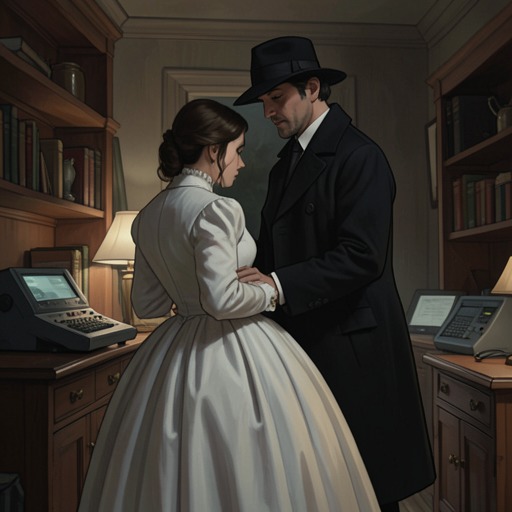
Aubert Gascoigne
The LuminariesAubert Gascoigne is a clerk at the Magistrate’s Court in Hokitika, a newcomer whose courteous manner and careful observations give him access to people and secrets across the town. Though his official work is low-ranking, his knowledge of bail, records, and maritime insurance makes him consequential in several disputes. His conduct is neither simply disinterested nor wholly calculating: he conceals Anna Wetherell’s gold, seeks Lydia Wells’s favor, and offers Francis Carver a route to recover money from the wreck of the Godspeed.
Identity and official position
Gascoigne introduces himself to Walter Moody with a clipped, courteous manner and an identifiably French accent. He opens a silver cigarette case and selects a cigarette as he speaks, presenting himself with polish and confidence. He already knows Moody’s name from reading the West Coast Times, where Moody had written an opinion on behalf of the Magistrate’s Court. The exchange establishes Gascoigne as a reader of local news as well as an attentive observer of the people around him.
His appearance initially leads Joseph Pritchard to assume that he holds influence at the court. In fact, Gascoigne’s responsibilities are limited. His main duty is collecting bail each day from the gaol-house at the Police Camp; he also records fees, checks receipts for miner’s rights, receives complaints, and occasionally runs errands for the Commissioner. Newly arrived in town, he is content to have a position but does not expect to remain on a low wage indefinitely. The gap between his modest office and his ambitions helps explain his readiness to build useful connections.
Gascoigne’s humor can be pointed. When Moody tries to infer the identity of a woman mentioned in the arrest notices, Gascoigne teases him before identifying her as Anna Wetherell. He later remarks on the symmetry of Anna having been tried for trying to take her own life. The joke is characteristic of his quickness with language, though it also shows how readily a serious predicament can become a subject for social wit.
Anna Wetherell and the gold
Gascoigne becomes involved in Anna’s affairs when he encounters her in custody and learns that she has gold sewn around her corset. He recognizes the grounds for suspicion: Anna has been detained for public intoxication, her clothing is dirty, and she appears to be under the influence of opium. He knows that he could report her and that he has no reason, in the ordinary course of his duties, to accept her claim that the concealed metal is hers. He even considers using the hunting knife in his boot to open the garment, on the assumption that the gold may not belong to her.
Instead, Gascoigne helps her meet bail. He uses his purse and ledger to conceal coins in his hand, then asks whether she can raise the required one pound and one shilling from the money she has shown him. The arrangement involves a falsehood to the gaoler and a deliberate decision to keep Anna’s secret. He also invites her back to his home. His help is not presented as pure charity: Anna senses that he expects a reward, and his abrupt questions and distracted manner suggest that he is hoping for one. As she handles a gold nugget, its bubbled, partly melted surface gives the hidden wealth a concrete presence between them.
After Crosbie Wells dies, Anna wakes in gaol with a much larger quantity of gold sewn around her corset and no knowledge of how it came to be there. When Dick Mannering presses him for an account, Gascoigne admits that Anna asked for his help and that he chose to hide the metal because neither of them knew who had placed it on her or why. He estimates its value at well over one hundred pounds, probably more. He presents this as the whole truth as he understands it, distinguishing what he knows from what remains unexplained. His protection of Anna thus becomes both an act of concealment and a statement of the limits of his knowledge.
Gascoigne’s connection to Anna also appears in the aftermath of the gun incident at the Gridiron Hotel. When Pritchard hears a report and turns, he finds Gascoigne at the door. Gascoigne challenges Anna about the apparent attempt to frighten those around her and examines the cartridge. The evidence later confirms that a misfire occurred, that the bullet had vanished, and that a second shot was fired harmlessly into the headboard of Anna’s bed. A look of understanding passes between Gascoigne and Anna as they examine the cartridge. When Pritchard leaves them alone, Gascoigne opens his arms and Anna falls against him; his embrace is forceful and intimate, while Pritchard’s departure emphasizes his own isolation. Gascoigne’s concern is evident, even though the precise nature of their understanding is not explained in that scene.
Affection, social maneuvering, and Moody
Gascoigne’s feelings for Lydia Wells shape his conduct in ways unusual for him. Although he generally prefers to be maneuvered rather than to maneuver others, he agrees to engineer a surprise reunion between Lydia and Anna, relying on Lydia’s repeated assurance that the two women were once close friends. The favor requires social orchestration that normally makes him uncomfortable. His willingness to undertake it is linked to his being somewhat in love with Lydia: attachment prompts him not only to act against his habits but to alter them.
His dealings with Lydia also reveal his capacity to give an account of events plainly when evasion becomes too tiring. After Anna’s gun misfires, Gascoigne recounts what happened. Lydia questions him, and he answers thoroughly, though exhaustion shows in his trembling voice. He accepts the chair and drink she offers. On another occasion, Gascoigne introduces Lydia and Moody, explaining Moody’s arrival from Scotland and Lydia’s role as the mistress of her establishment. He then warns Moody that Lydia is about to challenge his argument. The introduction and warning show him reading a room before its participants have fully acted.
Gascoigne deliberately cultivates Moody’s friendship. Over three weeks, they become cordial companions: they lunch together nearly every day, smoke cigars in the evenings at the Star and Garter, and play whist as partners. Gascoigne adapts himself to different social settings and can win favor when he chooses to make the effort. His ambition to befriend Moody is intense enough that, if Moody knew its extent, it might alarm him. Moody, for his part, regards Gascoigne as sophisticated and welcomes the chance to converse with an intellectual equal. Their friendship is therefore both genuine in its shared routines and shaped by Gascoigne’s purposeful attention to influence.
In conversation about Emery Staines, Gascoigne registers a tension in Anna’s behavior. He recalls that she seemed to hold Staines in high regard and perhaps cared for him, yet now appears to be seeking profit from his presumed death. He does not claim certainty about her role; rather, he tells Moody that her conduct gives reason for doubt. This judgment reflects his habit of distinguishing an impression from a proven fact, even as he remains ready to suspect that affection and financial interest may coexist.
The Godspeed and maritime claims
Gascoigne’s interest in ships is described as that of a landlubber. For three weeks he visits the Hokitika spit to watch the damaged Godspeed being moved gradually closer to shore. Once the wreck is hauled onto the sand, he examines the visible damage more closely. His visits are partly a way to fill a free Sunday afternoon, but they also bring him into contact with Francis Carver, whom he approaches deliberately. Gascoigne recognizes Carver as a brute and does not particularly want his friendship; he nonetheless judges that Carver’s attention could prove useful.
The usefulness lies in Gascoigne’s research into protection and indemnity insurance, or P&I. He explains that shipowners may belong to an association and pay into a mutual fund that offers an additional form of cover. His inquiries establish that Alistair Lauderback had such protection for his ships, with nearly one thousand pounds available in credit for each. Carver could legally draw on the funds toward the costs of removing the wreck, provided he filed his appeal before the middle of May, when a year would have elapsed since the sale and Lauderback’s obligation concerning the Godspeed would end.
Gascoigne reaches this conclusion through specific research rather than guesswork. He makes inquiries at Balfour Shipping, consults the Times archives, visits the Harbourmaster’s office, and checks with the Reserve Bank. He identifies Lauderback’s membership in the Garrity Group, a small cooperative of shipowners. The information gives Carver a possible means to meet the wreck’s expenses, which he complains may leave him a thousand pounds out of pocket. Gascoigne’s offer of assistance thus joins his professional curiosity to a practical attempt to secure Carver’s regard.
Later, while reviewing papers associated with the claim, Gascoigne notices that the Godspeed’s bill of sale bears the signature Francis Wells. He understands that Carver bought the ship under the alias Wells, not Crosbie Wells’s own identity, and studies the signature’s first letter, which could be read as either an F or a C. Lauderback then tells him directly that the buyer gave the name Francis Wells and was in fact Carver. Gascoigne does not convert this disclosure into an accusation. He observes that Carver’s correspondence presents him as acting on behalf of the dead Mr. Wells and that, on the evidence available, no law appears to have been broken. His response is legally cautious, but it also leaves the fraud’s moral implications unresolved.
Judgment, limits, and narrative role
Gascoigne’s position repeatedly places him between official procedure and private knowledge. He collects bail but secretly helps Anna; he knows that Carver used an alias but explains how Carver may still present himself as a proxy for a dead shipowner. At the same time, he does not pretend to know the source or purpose of the gold hidden on Anna. His statements are shaped by what can be established, what can be proved, and what he chooses to conceal.
He is also not included in every circle of local power. Gascoigne remarks that he has not been invited to the secret council at the Crown Hotel, acknowledging that his proximity to events does not give him access to all their plans. His knowledge is substantial but partial, gathered through records, conversations, and observation rather than command of the town’s affairs.
At Anna’s court proceedings, Gascoigne appears as a witness. His testimony confirms the misfire, the missing bullet, and the second shot into the bed’s headboard. He acknowledges that he had not suspected Emery Staines might have been at the Gridiron Hotel on the afternoon of January 27, but agrees with Moody that the possibility is plausible. The testimony brings together the traits that define him throughout the story: he is attentive to evidence, willing to admit the limits of his earlier understanding, and implicated in the private arrangements that formal proceedings attempt to clarify. As a clerk, friend, would-be lover, and investigator of insurance claims, Gascoigne makes the town’s scattered secrets legible without ever becoming their sole authority.